Get started with Harvey and Mary
Last updated: October 9, 2026

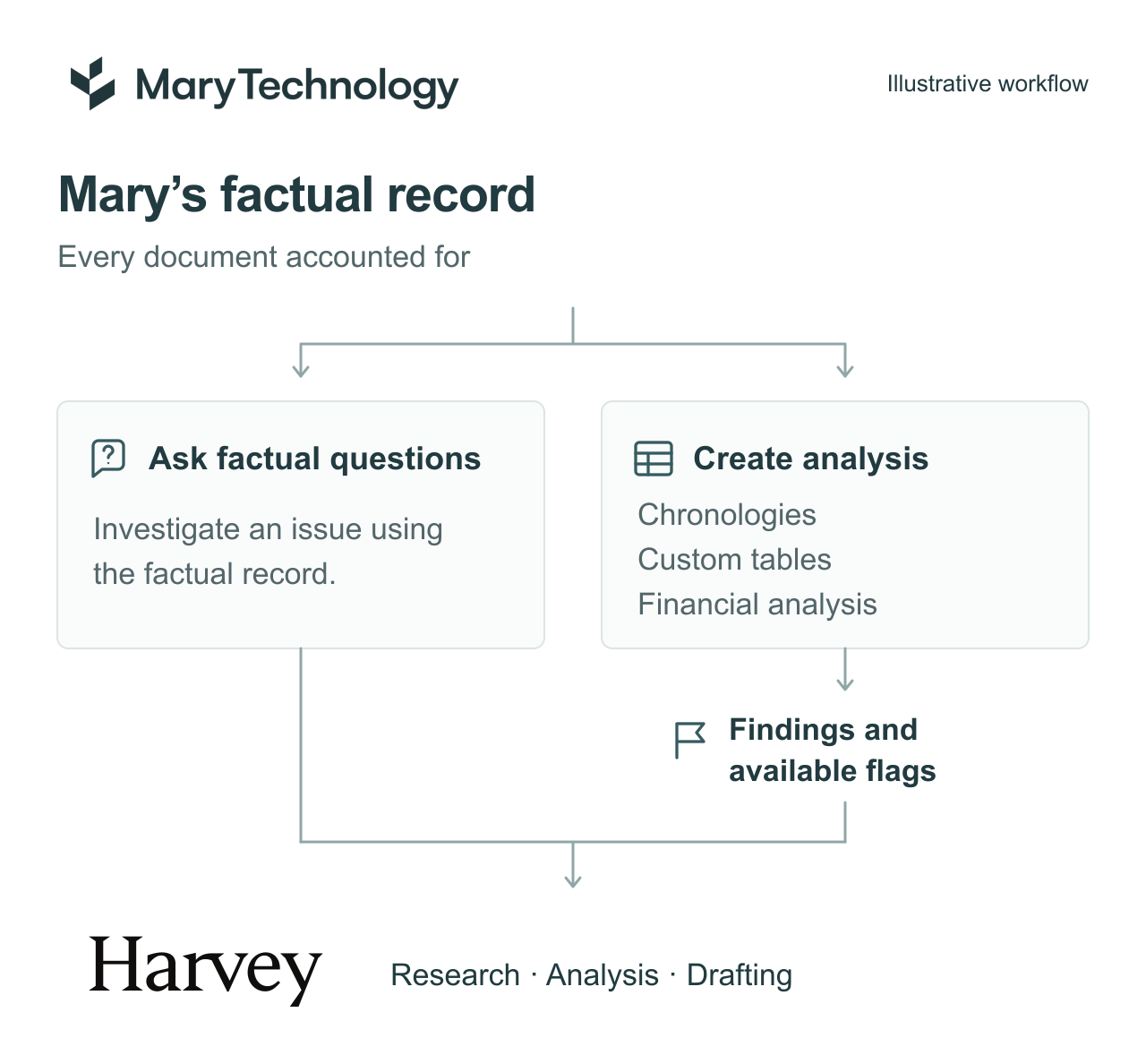
Bring Mary’s factual record into Harvey to investigate allegations, compare competing accounts and prepare analyses, advice, briefs and correspondence. You can also use findings and available flags from analysis you create in Mary.
You can ask Mary questions through Harvey. Open Mary when you need deeper source inspection or to review and correct the underlying work.
1. Connect Harvey and Mary
You need active Harvey and Mary accounts. Your Harvey administrator enables the connector once, then each person connects their own Mary account.
Administrator: enable the connector
In Harvey, go to Settings → Connectors.
Find Mary and approve it for your workspace.
Each user: connect your account
In your personal Settings → Connectors, select Mary.
Choose Connect and sign in with your Mary login.
Check the connection
Ask Harvey:
Show me my matters in Mary.
Check that the matter you intend to use appears. If it is missing, confirm that you can open it using the same account in Mary.
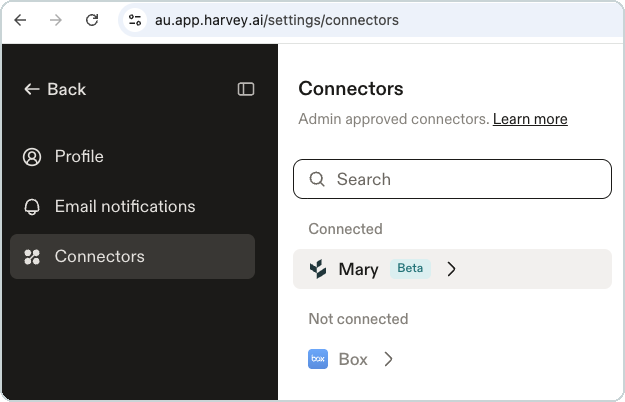
Harvey Settings, Connectors, with Mary listed under Connected.
2. What Mary adds to your work in Harvey
Prepare and review the factual record in Mary, then use it in Harvey for research, analysis and drafting. Check important findings and their sources in Mary, carry the reviewed work into your Harvey task, and review relevant updates as the matter develops.
Depth and exhaustiveness you trust.
Mary is a dedicated litigation fact layer. Mary reads and processes the whole matter before anyone asks a question. Your question decides what gets shown, not what gets read.
Your questions can build on that factual preparation: investigate what a party knew, test the evidence supporting an allegation or examine competing explanations across several parties.
Findings and flags to investigate
Flags become available in analysis you create in Mary, such as chronologies, custom tables and financial analysis. Creating a matter or uploading documents alone does not create these flags.
Mary’s flags draw attention to points that deserve closer examination:
Flag | What to examine |
|---|---|
Contradiction | Accounts or evidence that may conflict. |
Gap | Missing information relevant to a finding. |
Corroboration | Evidence supporting another account or finding. |
Allegation | A claim that needs to remain attributed to its source. |
Low Quality | A source-quality issue that may affect the finding. |
Once the relevant analysis is complete, ask Harvey to show its available flags, explanations and supporting sources. Use them to decide which findings need closer examination and what further evidence to seek.
For example, the documents might establish that an engineering concern was recorded but leave a gap about who received it. That missing link could determine which correspondence to request or what to ask a witness.
Factual work you can carry forward
Bring facts, Ask Mary answers and existing work from Mary into your next task in Harvey. Use the findings to prepare a pleading matrix, develop witness questions, investigate financial issues or draft advice using a firm template available in Harvey.
Review and correct the underlying factual work in Mary. When asking Harvey to use an existing chronology, draft or other available work, identify it by name. Check both whether a finding is supported and whether the relevant documents and events are represented in the work.
Example: test an argument against the record
In this Apple and Epic Games example, a user asks Harvey for events supporting an argument. Using an existing Mary chronology, the response also identifies material that challenges the argument and gaps that need further investigation.
The counterpoints draw on chronology entries. The gaps draw on Mary’s recorded flags. Together, they help the reviewer see which evidence to examine and which questions remain unresolved.
Select either screenshot to enlarge it.
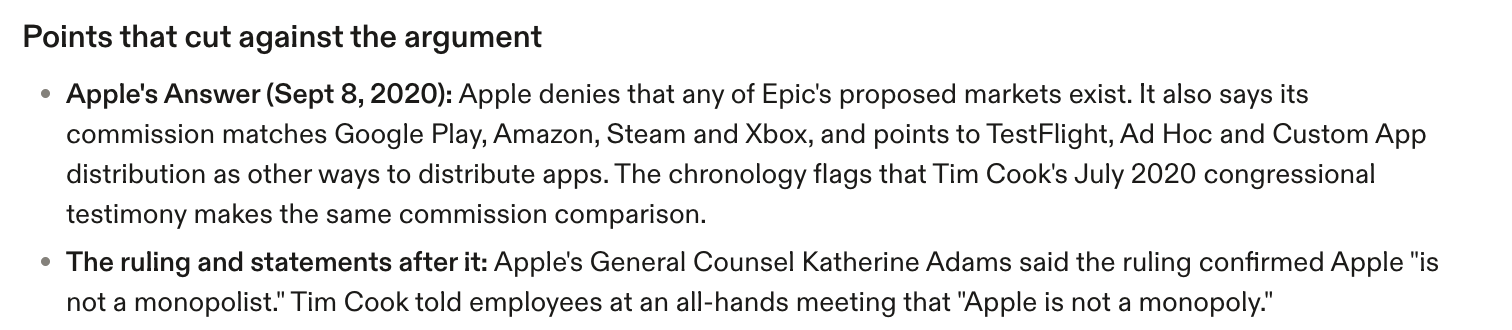
Harvey draws on Mary’s chronology entries to identify material that challenges the argument.
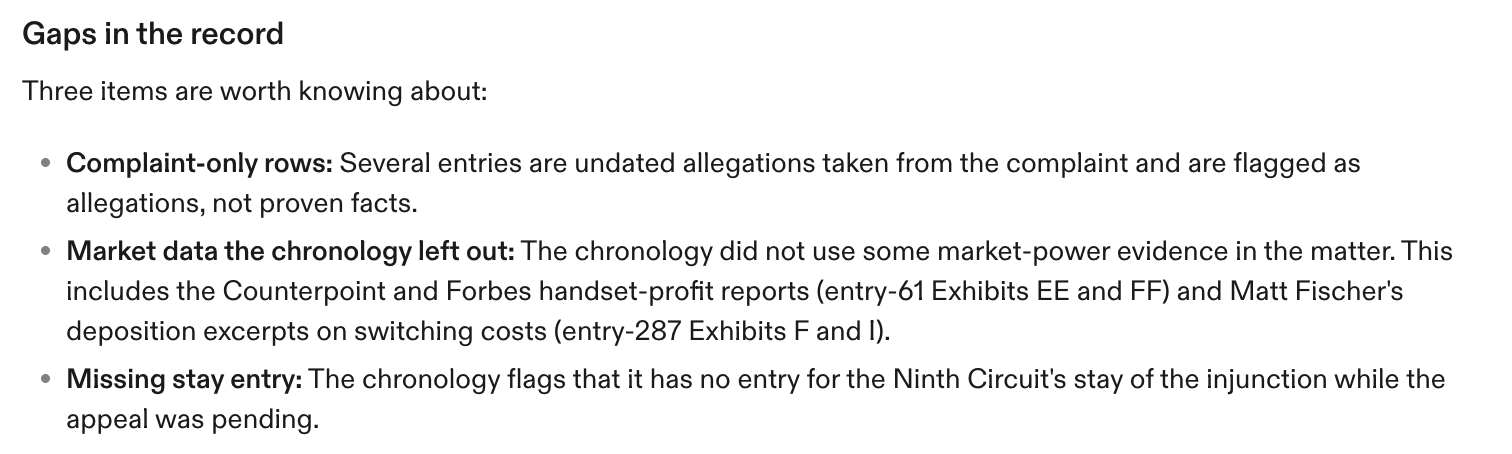
Harvey brings Mary’s recorded flags into the response, highlighting gaps and qualifications to investigate.
A gap in an existing chronology does not necessarily mean the document is missing from the matter. In this example, some material was present but had not been included in the chronology.
Check the scope and sources. This example searched the chronology for “monopoly”; relevant entries may use different wording. It returned source filenames and page references rather than clickable document links. Open the underlying work and source documents in Mary to check the findings and their context.
3. Try your first investigation
Choose a matter you know. If its documents are not yet in Mary, upload them there and allow processing to finish.
Once your matter is created, you can start with any tool or analysis you wish. Replace the text in square brackets with your details.
Investigate who knew what, and when
Using Mary, investigate the allegation that [party] knew about [problem] before [date] in [matter]. Distinguish when the problem arose, when it was identified, who received information about it and what that information established. Compare contemporaneous records with later accounts. Identify supporting and conflicting evidence, missing links and source references.
Examine Mary’s flags
What flags has Mary recorded in the work relevant to this issue? For each available flag, explain what prompted it, identify the supporting sources and suggest what we should check next. Distinguish Mary’s recorded flags from any additional issues you infer.
Open Mary to inspect important source passages, correct findings where needed and record your review decisions.
Continue into advice in Harvey
Using the findings I have reviewed above, draft advice to [client] about [issue], using [template made available in Harvey]. Explain the factual basis, preserve unresolved points and identify the further information we need.
4. Other investigations to try
Compare competing explanations
Using Mary, investigate the competing explanations for the delays in [project] in [matter]. For each material period, identify the cause alleged by each party, the records supporting or challenging those accounts, and any overlapping causes. Distinguish documented events from assertions about responsibility. Present an issue-by-issue table with sources and unresolved questions.
Examine financial evidence
Using Mary, examine whether the payments to [entity] during [period] are supported by the invoices, agreements and correspondence in [matter]. Show the recorded payments, the explanation supported by the documents, and any discrepancies or missing support. Account for identifiable reversals and duplicates, flag uncertain matches and include sources.
5. Keep your work current
When new documents arrive, add them in Mary and allow processing to finish. For supported existing work, Mary can flag relevant updates for review.
Review and apply the proposed changes in Mary, then ask Harvey to use the updated work by name.
Check earlier advice and drafts separately to decide whether they need revising.
Tips and support
Name the matter and work clearly. Use the names shown in Mary so Harvey can identify the intended material.
Review before relying on a result. Check material facts and citations in Mary, and review the final analysis or draft before sharing it.
Missing a matter? Check the connected Mary account and its access to that matter.
Incomplete answer? Check document processing and make the issue, people or period more specific. An empty answer does not by itself establish that the information is absent.
Need help? Use the help chat in Mary or email support@marytechnology.com. Include the step you were completing and any error message. The Mary team can also arrange a working session with your firm.